Everything comes wrapped in the winter, waiting for the hope of spring, helping you through the hibernation stage of the year. Spotify Wrapped gave me a listening age of 21, which made me giggle. Goodreads Year in Books hides the swings in my reading, from claustrophobic (The Safekeep) to heart-warming fiction (The Correspondent), from heavy non-fiction (The Myth of Normal) to non-fiction that sets a more explicit path to my unwrapping (Regenerative Leadership).
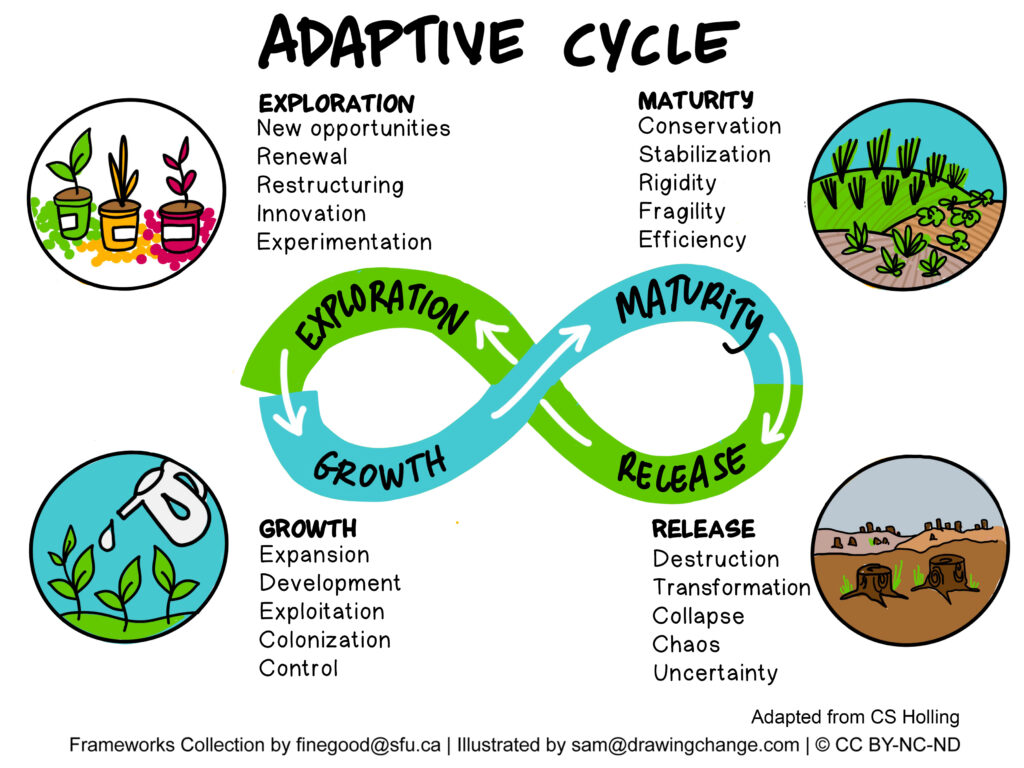
Regenerative learning is a constant theme for me. Sustainability is the word more widely recognised as describing the action of doing something to care for the environment, but it is rooted in the old, in sustaining, in a lack of recognition of the damage done and a disconnect from nature. Regenerative suggests a connection to nature, the power of rewilding our systems, of abundance and joy. The image of an adaptive cycle comes from the work of CS “Buzz” Holling, who started his work in forestry and became a leader in socio-economic and ecological complex adaptive systems. I was reminded of this thinking while reading Patrick Schmucki’s The Adaptive Edge newsletter. Regenerative learning suggests a cycle, growth, but also the possibility of failing and regrowth. Its organic connections suggest, for me, possibilities, and this blog is ultimately about that at a personal and professional level.

I was reminded by a post from Erin Remblance on LinkedIn of the power of a planetary perspective. Did you read the beautiful prose of Samantha Harvey in Orbital? Astronauts, like Ron Garan, describe our blue planet with awe and wonder as they track back and forth across the Earth, observing an “iridescent biosphere teeming with life”, lightning sparking over regions of the Earth. Similarly, Ellen MacArthur, a solo yachtswoman sailing around the world, also talked of awe and wonder, saying, “No experience in my life could have given me a better understanding of the word finite.”

A strong model of sustainability shows Nature surrounding Society, surrounding Economy. Without Nature, there is no Society, and no Economy. Weaker models show these three elements as pillars (think silos with limited interdependence). Economists turn the damage they do to the Environment into externalities that may be paid for in some miraculous way that doesn’t fix the problems caused. Human wellbeing is intrinsically linked to Nature in so many ways. Young people know this. As I support their projects beyond the formal classroom via EcoSchools, they make links to Nature and Wellbeing. We have projects that include helping children (and adults) connect to biodiversity, building insect homes, perennial plantings for pots that focus on climate resilience and even an outdoor gym that will encourage sporty young adults to be outside in nature. We even have data to support this need for connection with Nature (see newsletter).

Human flourishing is a growing focus for education. At the global level, the OECD published a report, “Education for Human Flourishing,” in November 2025. I learned about this in Tim Logan‘s interview with Michael Stevenson on the Future Learning Design Podcast. This could be an important push to education systems around the world, as PISA (Programme for International Student Assessment) may, in the future, start to assess countries on their success in implementing the report’s recommendations. The report identifies five competencies for Human Flourishing:
- Adaptive problem solving
- Ethical reasoning
- Understanding the world
- Appreciating the world
- Acting in the world
In his responses to Tim’s questions about Planetary Flourishing, Michael Stevenson was adamant about its underpinning of Human Flourishing and explained the pragmatic nature of report titles; they need to be snappy and usable by media sources. There is a danger, amplified by this simplification, that there is a focus on the human without the planetary. I’d like to highlight a couple of ideas on the planetary nature of human flourishing arising from this report, although I recommend exploring the whole report as it provides a rich exploration of the future of education, much of which you may recognise.

Ethical reasoning is defined as balancing one’s needs and wants with those of other people, species and the planet. This could include the concepts of intergenerational and interspecies justice. Understanding the world is defined as developing a perspective on global and intercultural issues by understanding, appreciating and synthesising different worldviews. This could include indigenous knowledge. Appreciating the world includes having a positive attitude towards the beauty of nature. In the final pages of the report, systems innovation and transformation are discussed, explaining that to achieve human flourishing, a system needs to be, among other features, regenerative, and cites Otto Scharmer’s Theory U.

What is missing, perhaps, is an acknowledgement that we need to understand both systems thinking and complexity science. Most human systems and all ecological systems are complex adaptive systems. This beaver dam in Switzerland hints at the emergent properties that arise from beavers in ecosystems, new habitats, more biodiversity and for me, delight. Switzerland has, I recently read, established a hotline for concerned citizens worried about this emergence. Systems thinking is a great way to understand and visualise the complexity of a system (read my blog); however, human complex adaptive systems require a different approach. Dave Snowden, founder of Cynefin, has helped me understand, through his many blogs and posts, that human complex adaptive systems require experimentation for any interventions towards systems transformation. Try many small experiments/projects in parallel and monitor their effect, look for unintended consequences, then do more of one and less of another when you start seeing the outcome. This requires brave leadership to let go and empower others and to trust in the sensing of a system that may not be defined by data and statistics, or at least the data that you are collecting. Read this Medium post by Jen Briselli for an Ice Hockey metaphor of complex adaptive systems that includes this sensing.

As I look back, before revealing the unwrapping, I realise how important attending the Warm Data Lab Host training in London in July 2023 has been in my own development (my blog). It was one of those opportunities which opened up via a path back to my friend, Jenny Gillett. It helped me trust my instincts again, to sense situations more openly, and to connect to what resonates with me. I’ve learned more about relational values, reciprocity, and indigenous knowledge, and focused on my relationship with nature (my blog). I’ve become clearer on the use of systems thinking, systems mapping and complex adaptive systems, through teaching ESS and my involvement with the IB Systems Transformation pilot course. I’ve infused my teaching of ESS with this thinking, and this is reflected in the thinking that I read and hear from my students. Many of the activities I design are used by teachers around the world through my InThinking ESS Subject Site. I’m thinking about how I can help teachers and schools do more to nudge the system into these hopeful places. This January, Jennifer Brandsberg-Engelmann and I start the year with a workshop for teachers about Regenerative Economics. I am developing a Think-In on using Systems Thinking in ESS, and I’m hoping to lead a couple of in-person workshops on systems thinking for interdisciplinary learning and intercultural awareness.
So, where does the unwrapping connect? I spent a very emotional time with my last classes in December, before our holiday, as I revealed that I’d resigned for the end of the academic year and would be leaving ISZL after 19 years in a variety of roles, including Personal Project Coordinator (3 years), AP Coordinator (8 years), DP Coordinator (11 years), and now HS Sustainability Lead (3 years). Another post on LinkedIn, this time by Peter Gamwell resonated strongly with me, connecting to Gregory Bateson’s thinking and back to Warm Data.
“Learning is the difference that makes a difference in a person’s life. Not just a change — a meaningful change. A felt shift. A new way of seeing, relating, imagining, or becoming.”
This encapsulates how I feel in my classroom and in the interactions I have with students and I will miss those daily moments immensely. Decisions are never easy but let’s see where this one leads me.
 zoesenvironment